THE LEGEND OF STRETCH AND BOBBITO
LISTEN TO THIS ARTICLE
There’s a version of hip-hop history where none of it happens at 1 a.m. on a Thursday. Where a kid from Queensbridge never gets handed a mic before he’s finished the album that will make him a legend. A sixteen-year-old from Bed-Stuy raps into a cheap studio microphone and nobody bothers to hit record. Where two friends who liked the same records never get a four-hour window on a college radio dial to find out what happens when you just let the tape run.
Good thing we’re not on that timeline. Instead… on October 25, 1990, a college freshman named Adrian Bartos aka Stretch Armstrong turned up at WKCR (Columbia University’s student station) and changed the shape of Hip-Hop: forever.
The Odd Couple on 89.9
Stretch had been DJing clubs since his teenage years, chasing promos and studying records like scripture. His partner, (Robert “Bobbito” Garcia) brought something Stretch didn’t have: a Rolodex. Bobbito was working radio promo for Def Jam, which meant he knew everybody and everybody owed him a favor. Stretch had the ear. Bobbito had the room. Together, they had a show.
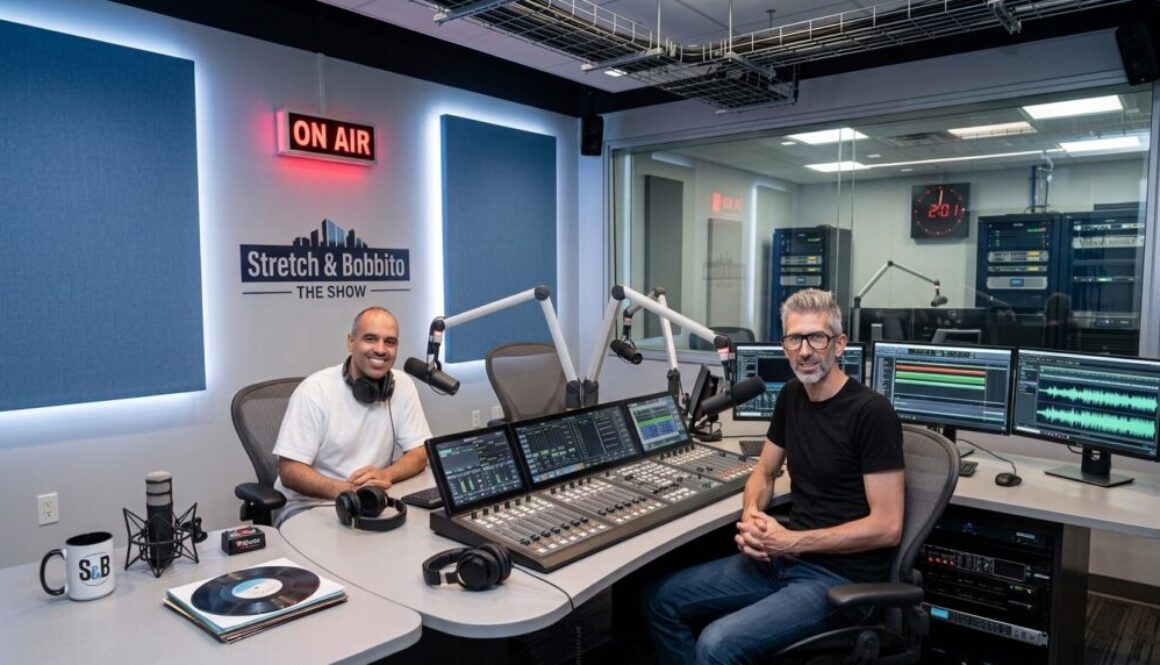
It shouldn’t have worked. A club DJ and a label promo guy, broadcasting out of a cramped studio in Upper Manhattan in the dead of night. They had no competition because nobody sane was awake to compete with them. But that emptiness was the point. There was no program director hovering behind glass, no commercial break every twelve minutes and no rulebook. Just four uninterrupted hours, crates of records and an open mic that a rapper could walk up to and get busy.
In hindsight, that absence of structure “IS” the whole story. Commercial radio had format. Stretch and Bob had time and in hip-hop… time is oxygen. A freestyle could breathe as long as it wanted. A DJ could blend a record nobody else in the city had. And because it was college radio, nobody was going to get fired for playing something too raw and/or unfinished.
The Room Where It Was Still Being Decided
Word moves strange in a pre-internet city. It doesn’t need Wi-Fi, just cassette decks and people who trust each other’s taste. Within months, the tiny WKCR studio had become a waiting room for a generation of rappers who didn’t have deals yet but were auditioning for the future.
A kid from the Queensbridge houses came through with rhymes that hadn’t made it to tape yet. He sharpened bars (in real time) that would later be featured on one of the most acclaimed debut albums ever made. Nobody in that studio fully understood that they were listening to hip-hop’s next great poet workshop his own mythology out loud.
Later would come a night that’s still spoken about by people who weren’t even born for it. Two unsigned MCs, (one from Harlem and one from Brooklyn) trading verses back and forth on the same mic. Both of them fully aware that they were witnessing greatness in the other. Cassette copies of that session moved through the city like contraband.
And then there’s the one that almost didn’t survive. A round-faced sixteen-year-old from Bed-Stuy came up near the end of a broadcast (close to dawn) unannounced and unremarkable in the moment. Just another kid with something to say. Stretch, who only bothered recording when he had a fresh tape loaded, nearly missed it entirely.
Decades later… watching old footage for a documentary about the show, both hosts heard that freestyle again for the first time since the night it happened. They realized, with something between joy and disbelief, that they’d been sitting on one of the earliest recorded verses of a rapper who would go on to become one of the greatest to ever do it.
They’d simply forgotten they had it. That’s how ordinary greatness sounded in that room (before the world caught up).
Wu-Tang came through deep (as usual). A young, unknown Fugees checked in. Souls of Mischief crossed the country for a session. Future icons wandered in and out of that studio the way regular people walk into a corner store. The thing is… almost nobody in the room knew which of them would become myths.
[mailpoet_form id=”4″]
Bootlegs, Prison Mail, and the Fashion World
Here’s the part that turns a great radio show into a legendary one: the show’s audience refused to stay where it belonged.
Fans dubbed the broadcasts onto tapes and passed them from hand to hand and mailbox to mailbox.
Tapes made it into prisons, where inmates traded them like currency and word-of-mouth did what algorithms do now. It pushed the show’s reputation into corners of the country that had never heard of Columbia University and never would have tuned to a college radio dial on purpose.
Uptown art galleries and downtown sneaker shops picked it up too. An audience the hosts never targeted and could never have predicted. People weren’t just listening for the exclusives. They were listening because the show felt like the one place left where the culture hadn’t been packaged yet. But a spot where you could hear it get made.
Eventually, the bootlegging got so out of control that Stretch and Bob started releasing the tapes officially through Fat Beats. You can’t buy that kind of grassroots reach. You can only earn it by being good enough for long enough, that people risk trouble to spread you.
The Bigger Stage, and What Got Lost Climbing It
By 1996, the show had outgrown college. The city’s dominant commercial hip-hop station (Hot 97) came calling. Stretch and Bob (of course) said yes to the exposure and paycheck. But commercial radio came with rules. No profanity, tighter structure and a station’s brand to protect.
So they split the difference: a sanitized set of hours for Hot 97 and their original uncensored four hours back at WKCR.
However, it couldn’t last both ways forever. Hip-Hop was shifting, commercial radio was tightening and by the show’s final broadcasts… Stretch and Bob had already given Hip-Hop more than a decade of unfiltered air.
Legendary, Officially
In 1998, The Source — hip-hop’s paper of record at the time — crowned it the best hip-hop radio show of all time. Years later came a documentary, built from Stretch and Bobbito’s own cassette archive, that reunited them with the artists they’d helped launch, many of whom were by then some of the most decorated names in music history, to sit and listen back to who they used to be. Broadcasting’s own institutions eventually inducted the pair into their hall of fame — recognition for a show that never once ran during hours a normal person would call prime time.
But the plaques and titles aren’t really what make people call it legendary. It’s the timing of it — that the show existed in exactly the years when a genre was still deciding what it would become, and that two friends with a shared record collection happened to leave the door open long enough for almost everyone who mattered to walk through it. Ask anyone who was in that room, at any hour, on any given Thursday: they’ll tell you they didn’t know they were watching history happen. They just knew the music was good, the mic was open, and somebody was always about to say something worth staying up for.
So, Salute to Stretch and Bob for being true Hip-Hop Originators
[yop_poll id=”1″]
Here’s a homage playlist highlighting some of the artists and records they broke.